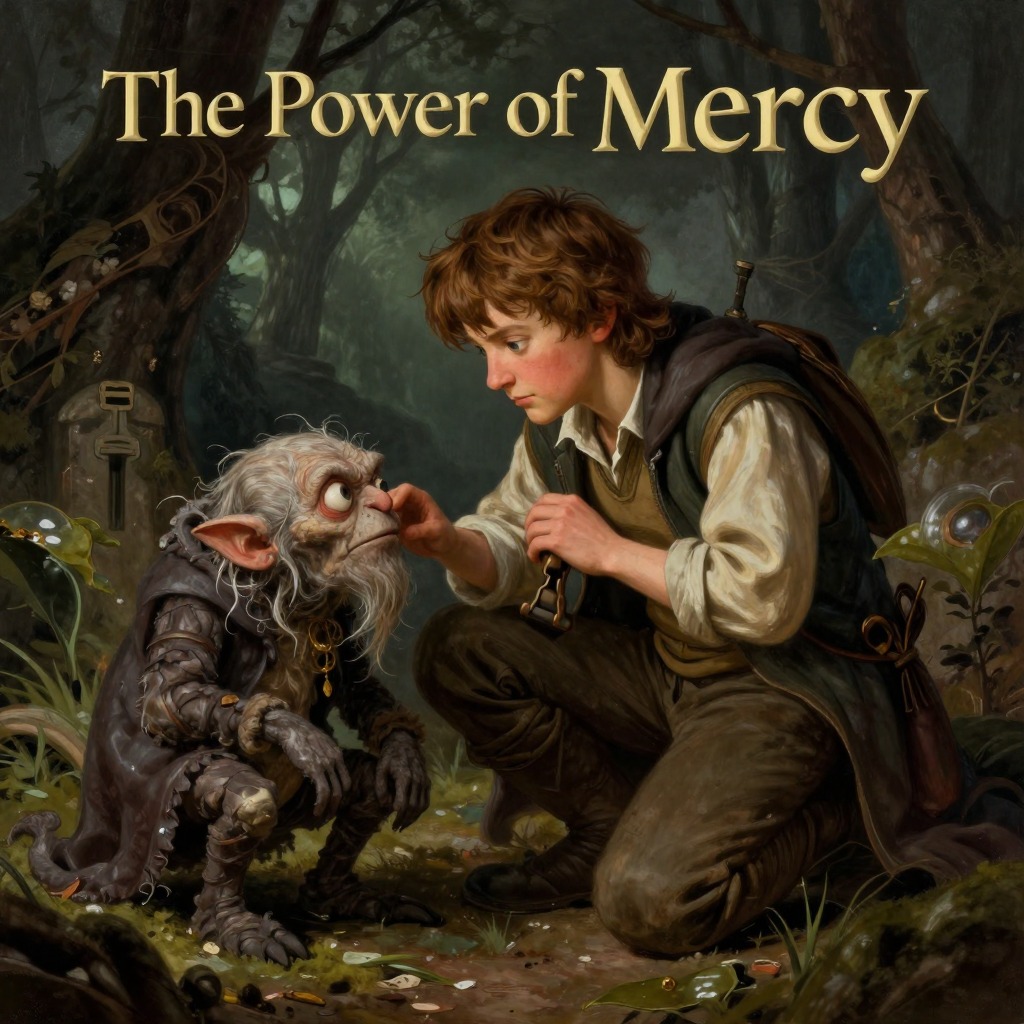
Bilbo Jumps Over Gollum
Bilbo Baggins, a comfort-loving hobbit who had never before faced true danger, found himself in the most desperate moment of his life deep under the Misty Mountains. Having lost the dwarves and the wizard Gandalf, he had stumbled into the subterranean lake of the creature Gollum and, after a tense riddle-game, had won a promise of guidance out of the darkness. But when Gollum discovered that his precious golden ring was missing—a ring that made its wearer invisible—he flew into a murderous rage, and Bilbo realized that the creature meant to kill him. In that instant, the hobbit's survival instinct and a newly awakened courage fused into a single, decisive action: a leap over Gollum's head that carried him past the creature and into the passage that led to freedom. This act was not merely a physical escape; it was the moment Bilbo fully embraced the Tookish side of his nature, the adventurous streak inherited from his mother Belladonna Took, and it set the course for the rest of his journey, including his discovery of the ring's power of invisibility.
The Setting and the Stakes
Bilbo had been wandering alone in the absolute blackness of the goblin tunnels after being separated from the dwarves during their escape from the Great Goblin's cavern. His only light was the faint gleam of his elvish dagger, Sting, which he had taken from the trolls' cave. He had come to a cold underground lake, and there he encountered Gollum, a small, slimy creature with pale, lamp-like eyes who lived on a rocky island in the water. Gollum, who had lost all his friends and crept down into the dark long ago, proposed a riddle-game: if Bilbo won, Gollum would show him the way out; if Gollum won, he would eat the hobbit. The game was ancient and sacred, and even wicked creatures feared to cheat at it. Bilbo, with his wits sharpened by fear, managed to ask a final, desperate riddle—"What have I got in my pocket?"—which Gollum could not answer in three guesses. The creature, bound by the rules, promised to lead Bilbo to the exit, but he first returned to his island to retrieve his "birthday-present," the golden ring that made him invisible. When he found it missing, he realized Bilbo must have taken it, and his rage turned murderous. The stakes could not have been higher: Bilbo was lost, alone, and facing a creature that could see in the dark and was now bent on killing him.
The Leap Itself
As Gollum, his eyes burning with a green fire of loss and suspicion, paddled his boat back to the shore and sprang toward the hobbit, Bilbo turned and ran blindly back up the dark passage. He stumbled, fell, and in that moment of terror, his hand found the ring in his pocket. It slipped onto his finger, and Gollum, who could see in the dark, passed by him without a glance, cursing and whispering. Bilbo, now invisible, followed the creature, hoping to be led to an exit. Gollum, muttering to himself, revealed that he suspected Bilbo had found the ring and that the hobbit must be heading for the "back-door." He led Bilbo to a low opening, but then stopped, afraid of the goblins he smelled beyond. There, Gollum crouched in the entrance, tense and alert, his senses sharpened by the darkness. Bilbo, desperate and knowing he must act, felt a sudden understanding and pity for the miserable creature—a glimpse of endless, unmarked days without light or hope—but also a new strength and resolve. In a flash, he leaped. It was no great leap for a man, but a leap in the dark: straight over Gollum's head, seven feet forward and three in the air, barely missing the low arch of the passage. Gollum threw himself backward and grabbed, but his hands snapped on thin air. Bilbo, falling fair on his sturdy feet, sped off down the new tunnel, leaving Gollum defeated, shrieking "Thief, thief, thief! Baggins! We hates it, we hates it, we hates it for ever!"
Consequences and Transformation
The leap was the turning point of Bilbo's underground ordeal. It was not a fight—he had not stabbed the creature, though he had the chance—but a clean escape that required both physical courage and a moral choice. He had pitied Gollum, and that pity, mixed with horror, had stayed his hand. Yet he had also acted with a decisiveness that surprised even himself. The leap carried him into a passage that led, after a long and terrifying journey past goblin guards, to the open air and the sunlight. It was there, at the very door of the mountain, that he first used the ring to become invisible, slipping past the goblins who guarded the exit. When he rejoined the dwarves and Gandalf, he told them of his adventures but kept the ring a secret, sensing its importance. The leap over Gollum thus marked the moment Bilbo ceased to be merely a reluctant burglar and became a true adventurer, one who could act with both courage and compassion. It also sealed his possession of the One Ring, an object that would shape the fate of Middle-earth, though he did not yet know its full power. The event became a foundational story in his own legend, a tale he would later recall with pride, and it demonstrated that even a small hobbit from the Shire could, when pressed, find within himself the strength to overcome the darkest of foes.